
Cubital Tunnel Syndrome
Cubital Tunnel Syndrome is caused by compression of the ulnar nerve as it passes around the inside of the elbow – the same nerve that produces a “tingling” sensation when you hit your “funny bone”. When compressed, the nerve can cause numbness and tingling in the ring and little fingers, weakness of grip, and pain around the elbow or forearm. Early treatment can relieve symptoms and prevent permanent nerve damage. Options range from activity modification and splinting to surgical release or nerve repositioning for more advanced cases.
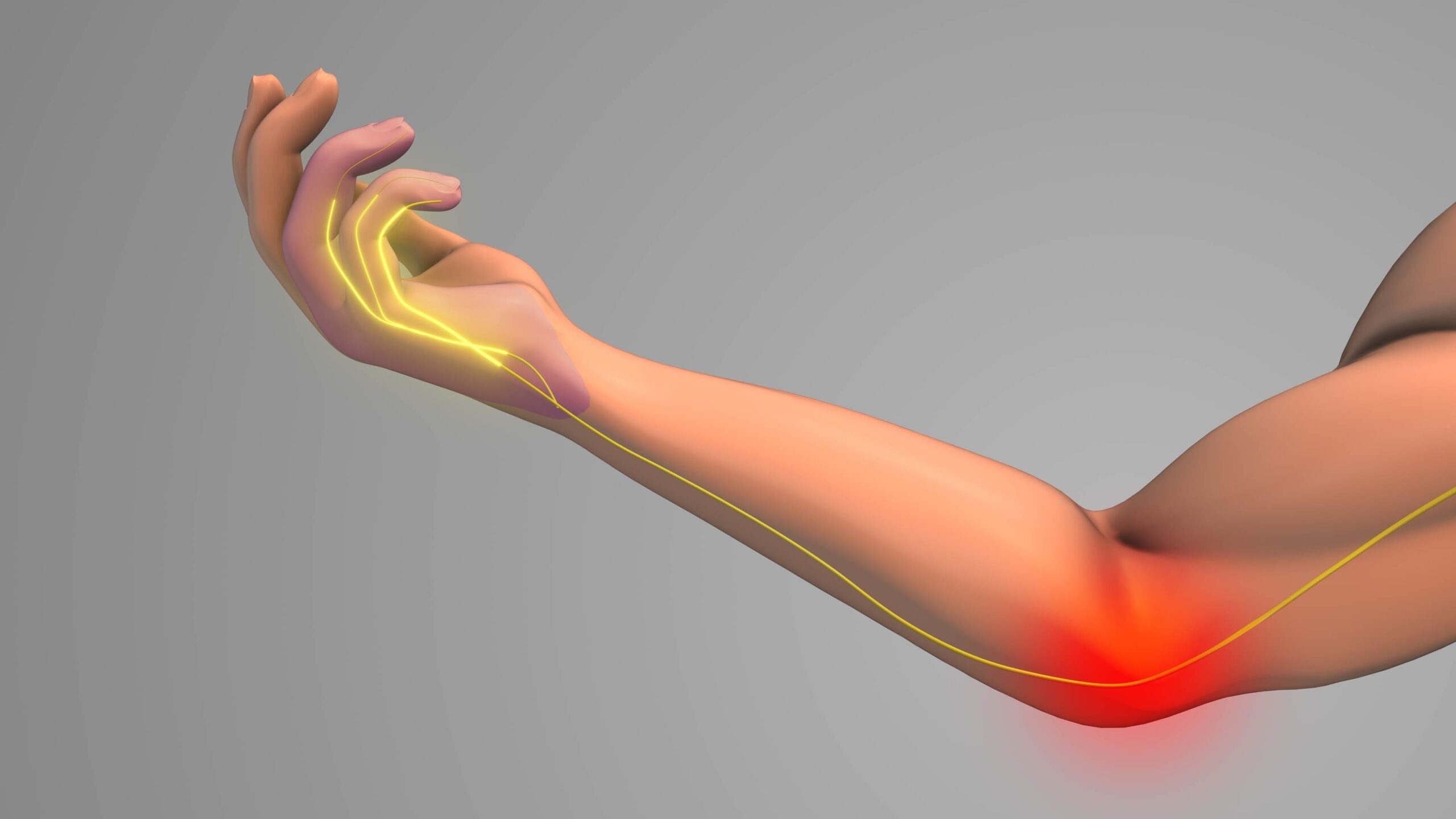
Common Symptoms
- Numbness and tingling in the ring and little fingers
- Aching or burning pain on the inner side of the elbow or forearm
- Weakness of grip or pinch strength
- Hand clumsiness or difficulty with fine tasks
- Symptoms worse at night or when the elbow is bent for long periods
Typical Causes
Cubital Tunnel Syndrome occurs when the ulnar nerve is stretched as it passes behind the bony prominence of the inner elbow (i.e. the medial epicondyle). This can result from prolonged elbow flexion, repetitive leaning on the elbow, direct trauma, or thickening of surrounding soft tissues. Some people are more prone due to their anatomy. For example, a shallow groove that allows the nerve to subluxate or “snap” over the bone.
Seek urgent help if
You develop constant numbness, severe weakness, or wasting of the hand muscles. These signs may indicate advanced nerve compression requiring prompt specialist assessment to prevent permanent loss of function.
Call 999 for emergencies, or NHS 111 for urgent advice.
On this page:
Symptoms
Symptoms often begin gradually with intermittent tingling or numbness in the little and ring fingers, particularly when the elbow is bent (for example, holding a phone or reading in bed). Pain or aching may radiate along the inner forearm or up towards the shoulder.
As the condition progresses, numbness may become constant, and patients may notice weakness or clumsiness when gripping objects or performing fine tasks such as buttoning clothes. In advanced cases, the hand may develop visible muscle wasting (particularly between the thumb and index finger), and the ring and little fingers may start to curl into a claw-like posture.
Causes / Risk Factors
The ulnar nerve runs through a narrow passage called the cubital tunnel behind the elbow. It is vulnerable to compression or stretch at this point.
Common causes and risk factors include:
- Repetitive or prolonged bending of the elbow (e.g. sleeping with elbows bent)
- Leaning on hard surfaces or using elbows as support at a desk
- Direct trauma or previous elbow fracture/dislocation
- Cysts, arthritis, or thickened ligaments compressing the nerve
- Anatomical variation causing the nerve to subluxate (move over the bone)
- Diabetes or thyroid disease increasing nerve susceptibility
The condition is more common in middle-aged adults and in those with occupations or hobbies involving frequent elbow flexion.
Investigations & Diagnosis
Diagnosis is made through clinical assessment and nerve conduction studies.
Typical findings include:
- Reduced sensation in the little and ring fingers
- Weakness of grip and pinch strength
- Positive Tinel’s test – tingling when tapping over the cubital tunnel
- Visible wasting in advanced cases
Investigations may include:
- Nerve conduction studies (NCS) / electromyography (EMG): measure how well the nerve conducts impulses and localise the site of compression.
- Ultrasound: visualises nerve thickening or movement over the medial epicondyle.
- MRI: occasionally used to identify structural causes such as cysts or arthritis.
These investigations help confirm the diagnosis and guide whether conservative or surgical treatment is most appropriate.
Treatment Options
Non-surgical
- Activity modification: avoiding prolonged elbow flexion or resting on the elbow can significantly reduce symptoms.
- Night splinting: keeping the elbow straight in a soft brace during sleep prevents prolonged compression.
- Physiotherapy: nerve-gliding exercises may help maintain mobility and reduce irritation.
- Analgesia or anti-inflammatory medication: may ease discomfort during flare-ups.
These measures are often effective in early or mild cases.
Surgical
Surgery is considered when symptoms persist despite conservative treatment or when there is significant weakness or nerve conduction abnormality.
Options include:
- Cubital tunnel decompression (simple release): freeing the nerve by dividing the tight tissues around it.
- Anterior transposition: relocating the nerve to a new position in front of the elbow to prevent stretch or recurrent compression.
- Medial epicondylectomy: removing a small part of the bony prominence to create more space for the nerve.
All procedures are performed under regional or general anaesthesia as day-case surgery. Your surgeon will recommend the most appropriate method based on anatomy, symptom severity, and nerve stability.
Recovery & Follow-up
Following surgery, the arm is usually supported in a light dressing or sling for a few days. Early gentle movement is encouraged to prevent stiffness. Stitches are removed after about two weeks, and physiotherapy may be advised to restore full function.
Nerve recovery can take several months, as healing depends on the degree of prior nerve compression and the distance between the elbow and the hand. Most patients notice improvement in tingling and night pain within weeks, although weakness or numbness may recover more gradually.
The majority of patients achieve significant relief and return to normal activities within 4–8 weeks.
When to seek urgent help
You should seek urgent review if you develop worsening numbness, new weakness, or severe pain after treatment. After surgery, increasing redness, swelling, or discharge from the wound should be promptly assessed to rule out infection. Persistent loss of hand control or muscle wasting requires early re-evaluation by your specialist.
Call 999 immediately or attend A&E if you have a new injury with loss of movement or sensation in the hand, rapidly spreading redness or swelling with fever, or sudden severe weakness.
Use NHS 111 for urgent same-day advice if your symptoms are getting quickly worse.
If you’re experiencing cubital tunnel syndrome or related symptoms, we can confirm the cause and tailor a plan – often starting with splints/hand therapy and exercises, with medicines, injections or surgery only where appropriate.
This page provides general information and is not a substitute for individual medical advice.
For emergencies (severe/new weakness, spreading infection, uncontrolled pain, significant injury) call 999, or use NHS 111 for urgent guidance.
Appointments:
- Self-pay patients can book without a GP referral
- Insured patients (Bupa, AXA, Aviva, Vitality, WPA, etc…) can book once authorised.
Clinics are available at:
- The Harborne Hospital – HCA, Birmingham
- Nuffield Health Wolverhampton Hospital
- The Priory Hospital, Birmingham
To book or ask a question, contact Vikki (Private Secretary):
☎ 07510 417479
✉ [email protected]