
De Quervain’s Tenosynovitis
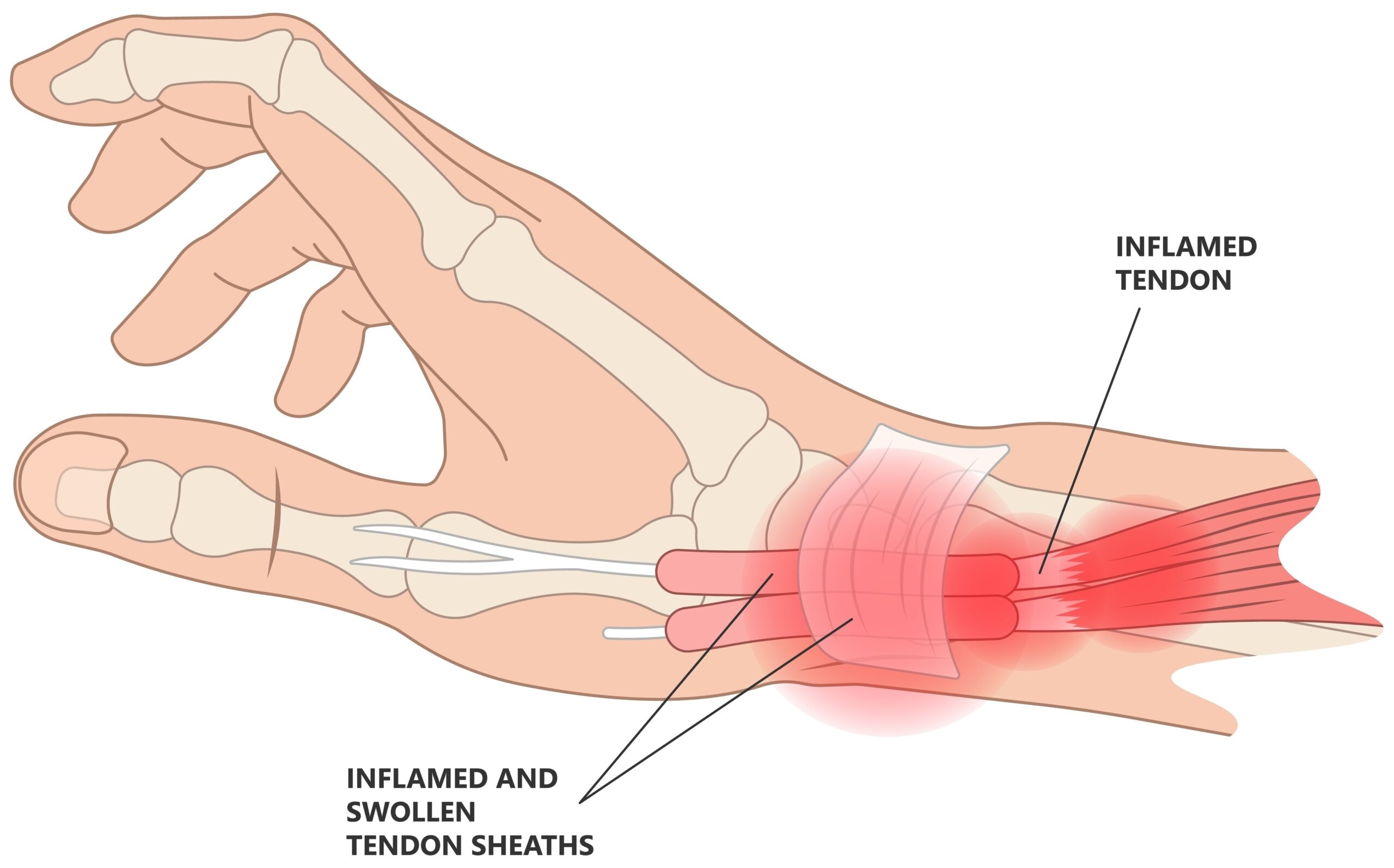
De Quervain’s tenosynovitis is a painful condition affecting the tendons on the thumb side of the wrist. It occurs when the tendons that straighten and lift the thumb become inflamed as they pass through a tight tunnel at the wrist. The condition often develops gradually and causes pain with gripping, lifting, or twisting movements. It is particularly common in new parents, people who use mobile phones or keyboards frequently, and those involved in repetitive hand or wrist activities.
Common Symptoms
- Pain on the thumb side of the wrist, especially with movement
- Swelling or tenderness near the base of the thumb
- Discomfort when gripping, lifting, or twisting objects
- Clicking or “sticking” sensation with thumb movement
- Worsening pain when bending the wrist towards the little finger
Typical Causes
De Quervain’s tenosynovitis is caused by irritation and thickening of the tendon sheath that surrounds the abductor pollicis longus and extensor pollicis brevis tendons. Repetitive thumb or wrist movements, overuse, or awkward wrist positions can provoke inflammation. Hormonal and fluid changes during pregnancy or after childbirth also make the condition more likely. It can affect anyone but is most common in women aged 30-50.
Seek urgent help if
You develop sudden, severe wrist pain after an injury, or if the wrist becomes red, hot, and swollen – these may indicate infection or a more serious underlying problem that needs immediate assessment.
Call 999 for emergencies, or NHS 111 for urgent advice.
On this page:
Symptoms
The hallmark symptom is pain on the thumb side of the wrist, particularly when gripping or lifting objects such as a kettle, baby, or phone. The pain often radiates into the forearm and may worsen when the wrist is bent towards the little finger. Swelling and tenderness are common, and some people notice a small, firm lump where the tendons pass over the wrist.
Symptoms can develop suddenly after a new repetitive activity or gradually over weeks. Activities that involve repeated lifting with the thumb outstretched – such as childcare, typing, or racquet sports – often aggravate the pain. In severe cases, patients may experience catching or a grating sensation when moving the thumb.
Causes / Risk Factors
De Quervain’s tenosynovitis occurs when the tendons that move the thumb become constricted as they pass through the first dorsal compartment of the wrist. This compartment acts like a tunnel, and inflammation causes friction each time the tendons slide through it.
Risk factors include:
- Repetitive wrist and thumb movements (typing, texting, lifting)
- New parenthood or frequent infant handling (“mother’s wrist”)
- Hobbies or jobs requiring forceful gripping or twisting
- Female gender and age 30-50
- Pregnancy or breastfeeding (hormonal and fluid changes)
- Rheumatoid arthritis and other inflammatory conditions
Investigations & Diagnosis
Diagnosis is usually made from the history and examination alone.
Key features include localised tenderness over the radial side of the wrist and pain during the Finkelstein’s test – when the thumb is placed in the palm and the wrist is bent towards the little finger, producing sharp pain along the tendon sheath.
Investigations are rarely needed, but an ultrasound scan can confirm tendon sheath thickening or exclude other causes of pain such as a ganglion cyst or early arthritis. X-rays are typically normal but may be used to rule out bone injury or degenerative change.
Treatment Options
Non-surgical
- Activity modification: Avoiding repetitive wrist or thumb movements and using ergonomic supports often helps symptoms settle.
- Splinting: A thumb-spica splint keeps the wrist and thumb at rest, reducing friction and allowing the inflammation to resolve.
- Corticosteroid injection: Injection into the tendon sheath is highly effective, providing long-term relief in around 80% of cases. It can be performed in clinic and usually takes effect within a few days.
- Anti-inflammatory medication and ice: May ease pain and swelling in the short term.
Surgical
If symptoms persist after non-surgical measures, De Quervain’s release surgery may be recommended. This day-case procedure involves releasing the tight sheath to create more space for the tendons. It is performed under regional or general anaesthetic through a small incision, and the tendons are checked to ensure free movement. The operation has a high success rate with a low risk of recurrence.
Recovery & Follow-up
After injection, most patients experience improvement within days, although mild tenderness may persist briefly. Following surgery, a light dressing or splint is applied, and early gentle movement is encouraged to prevent stiffness. Stitches are usually removed after 10–14 days. Most people return to desk-based work within a week, though heavy lifting or repetitive wrist movement should be avoided for about four weeks. Physiotherapy may be recommended to restore grip strength and flexibility. Long-term outcomes are excellent, with the majority of patients remaining symptom-free.
When to seek urgent help
You should seek urgent medical attention if you develop increasing redness, swelling, or discharge at the injection or surgical site, new numbness or weakness in the thumb, or worsening pain not relieved by rest. These may indicate infection or nerve irritation requiring prompt review.
Call 999 immediately or attend A&E if you have a new injury with loss of movement or sensation in the hand, rapidly spreading redness or swelling with fever, or sudden severe weakness.
Use NHS 111 for urgent same-day advice if your symptoms are getting quickly worse.
If you’re experiencing De Quervain’s tenosynovitis or related symptoms, we can confirm the cause and tailor a plan – often starting with splints/hand therapy and exercises, with medicines, injections or surgery only where appropriate.
This page provides general information and is not a substitute for individual medical advice.
For emergencies (severe/new weakness, spreading infection, uncontrolled pain, significant injury) call 999, or use NHS 111 for urgent guidance.
Appointments:
- Self-pay patients can book without a GP referral
- Insured patients (Bupa, AXA, Aviva, Vitality, WPA, etc…) can book once authorised.
Clinics are available at:
- The Harborne Hospital – HCA, Birmingham
- Nuffield Health Wolverhampton Hospital
- The Priory Hospital, Birmingham
To book or ask a question, contact Vikki (Private Secretary):
☎ 07510 417479
✉ [email protected]