
Dupuytren’s Contracture
Dupuytren’s contracture is a common condition that causes one or more fingers to bend gradually into the palm and become difficult to straighten. It occurs when the normal fibrous tissue beneath the skin of the palm (the palmar fascia) becomes thickened and forms cords. Although it is usually painless, it can interfere with hand function and make everyday tasks difficult. Treatment options include observation, radiotherapy for early disease, minimally invasive needle release, or surgery depending on severity and progression.
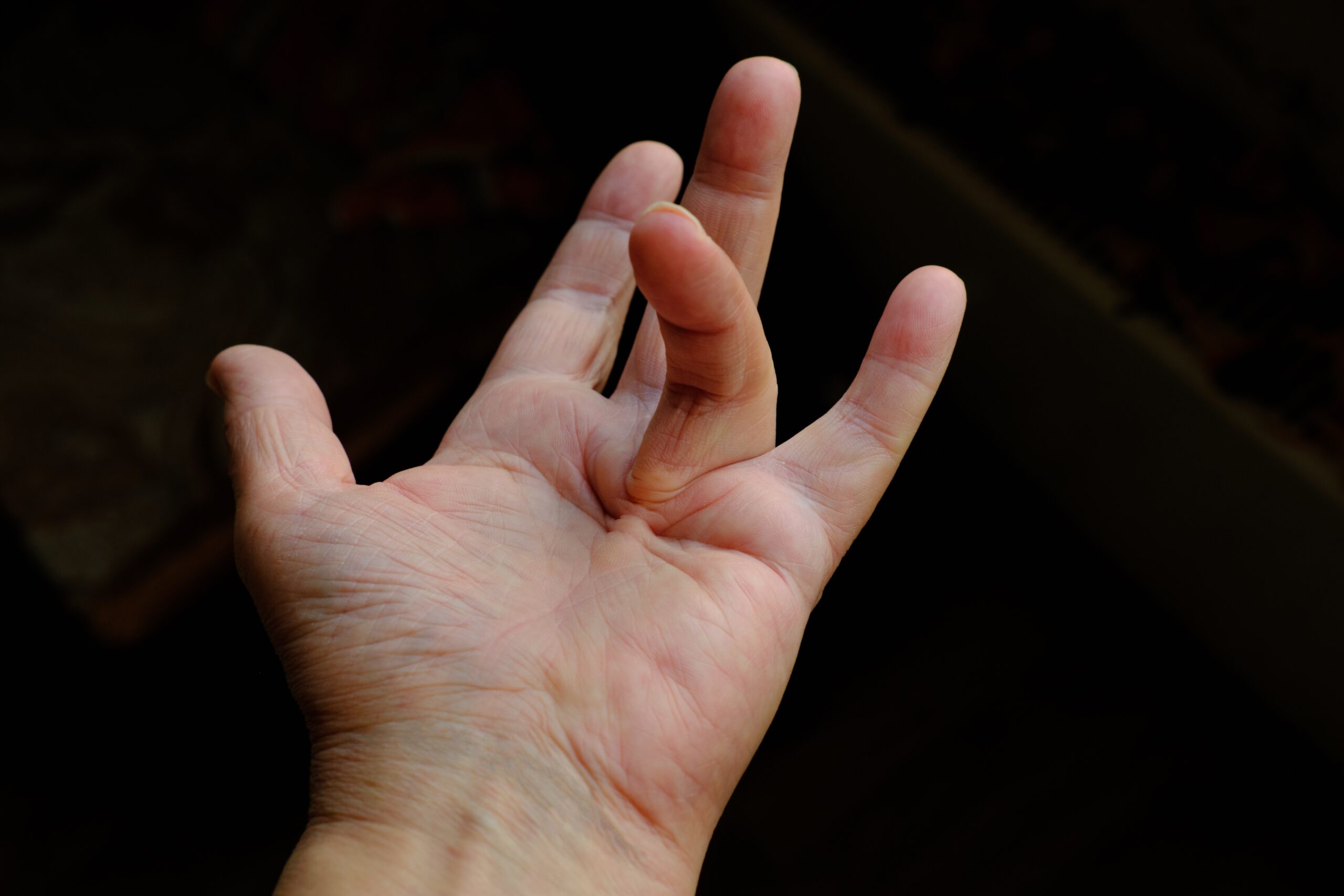
Common Symptoms
- Thickened cords or lumps in the palm, often near the ring or little finger
- Difficulty placing the hand flat on a table or surface
- Gradual bending (contracture) of one or more fingers towards the palm
- Tightness in the palm without significant pain
- Skin dimpling or puckering over the affected area
Typical Causes
Dupuytren’s disease is caused by abnormal thickening of the palmar fascia. It is more common in men over 40, often runs in families, and may be influenced by genetics, age, and lifestyle factors such as smoking and alcohol use. It is not caused by overuse or injury, although trauma or surgery can sometimes accelerate progression in a predisposed hand.
Seek urgent help if
You develop sudden pain, swelling, redness, or rapid worsening of finger contracture following an injection or procedure, or if there is any concern about wound infection or nerve injury after surgery.
Call 999 for emergencies, or NHS 111 for urgent advice.
On this page:
Symptoms
Dupuytren’s disease typically begins as a small, firm nodule in the palm, often near the base of the ring or little finger. Over time, the nodules can form fibrous cords that shorten and pull the fingers towards the palm. The process is usually painless, although some patients experience tenderness or itching early on.
In mild cases, the thickened tissue causes only a lump, but in more advanced stages, the affected fingers cannot be fully straightened. This makes it difficult to place the hand flat on a table or to shake hands, wear gloves, or put a hand in a pocket.
Causes / Risk Factors
The exact cause of Dupuytren’s contracture is unknown, but there is a strong hereditary component, particularly in individuals of Northern European / Viking descent. The disease results from overactivity of fibroblasts within the palmar fascia, leading to excess collagen deposition and contracture.
Risk factors include:
- Family history of Dupuytren’s disease
- Male gender (about 6:1 male-to-female ratio)
- Increasing age, usually after 40 years, more common in 60-70 year old
- Diabetes mellitus
- Epilepsy (partly related to long-term anticonvulsant use)
- Smoking and alcohol consumption
- Previous hand injury or surgery (which can trigger local changes)
Investigations & Diagnosis
Diagnosis is clinical, based on characteristic features of nodules and cords in the palm with associated finger contractures. The condition is usually painless and does not affect the tendons themselves.
Typical findings include:
- Fixed flexion deformity, most often affecting the ring and little fingers
- Positive table-top test – inability to place the hand flat on a table
- Skin pitting or adherence over the cords
No specific imaging or blood tests are usually required. Ultrasound or MRI is occasionally used if there is diagnostic uncertainty or to plan surgery in recurrent cases.
Treatment Options
Observation
In early stages where the hand can still lie flat, treatment is not always required. Regular monitoring and stretching exercises may help maintain motion.
Radiotherapy for Early Dupuytren’s Disease
Radiotherapy may be considered for selected patients with early, active Dupuytren’s disease, before a significant fixed finger contracture has developed. The aim of treatment is to reduce or delay progression of the disease rather than to straighten a finger that is already contracted.
NICE has published guidance on radiotherapy for early Dupuytren’s disease. It considers the evidence regarding effectiveness to be limited in quantity and quality. Patients considering radiotherapy should therefore have an appropriate assessment and discussion about the potential benefits, uncertainties and risks.
Some private medical insurers may require specialist assessment and onward referral before authorising radiotherapy. I can assess the severity and stage of Dupuytren’s disease, discuss the available treatment options and, where appropriate, refer patients for a specialist radiotherapy opinion.
For patients wishing to explore radiotherapy, further information is available from Dr Richard Shaffer at Dupuytren’s UK, who specialises in radiotherapy for early Dupuytren’s disease.
Minimally Invasive Options
- Needle fasciotomy:
A fine hypodermic needle (like one used to take a blood test) is used to divide the cord through a small puncture in the skin. This is normally performed under local anaesthetic. Skin tears in the palm can take 2-3 weeks to heal but most patients return to work much faster than a limited fasciectomy. It does however leave “lumps” in the palm, but the finger should be straighter. - Collagenase injection:
A specialised enzyme (no longer available in the UK but historically used) that dissolves the cord, allowing the finger to be straightened a few days later. Recurrence is similar to needle release.
Surgical Treatment
- Limited fasciectomy:
The most common and durable operation for established contracture. It involves excising the thickened fascia through a zig-zag incision while protecting nerves and tendons. - Dermofasciectomy:
Used for recurrent or aggressive disease, removing affected fascia and overlying skin, which is replaced with a skin graft. This offers lower recurrence but requires longer healing.
The choice of treatment depends on the severity of contracture, finger involvement, patient preference, and hand function requirements.
Recovery & Follow-up
After needle release, most patients regain hand function within a few days. Following open surgery, the hand is usually bandaged and elevated for the first 48 hours. Sutures are removed after 10-14 days, and hand therapy exercises are essential to maintain motion and prevent stiffness. Grip strength gradually improves over several weeks, and most patients can return to light activities within 2–3 weeks, though full recovery may take up to 8 weeks.
Recurrence rates vary depending on the deformity severity, type of procedure and aggressiveness of the underlying disease.
Return to desk-based work is often possible within 1–2 weeks, while manual workers may need 4–6 weeks before resuming full duties. Follow-up is arranged to monitor wound healing, satisfaction and recovery of hand function.
When to seek urgent help
Seek urgent review if you notice sudden severe pain, swelling, or signs of infection after treatment, or if your finger becomes acutely stiff and painful. After surgery, increasing redness, warmth, or discharge from the wound should be assessed promptly.
Call 999 immediately or attend A&E if you have a new injury with loss of movement or sensation in the hand, rapidly spreading redness or swelling with fever, or sudden severe weakness.
Use NHS 111 for urgent same-day advice if your symptoms are getting quickly worse.
If you’re experiencing dupuytren’s contracture or related symptoms, we can confirm the cause and tailor a plan – often starting with splints/hand therapy and exercises, with medicines, injections or surgery only where appropriate.
This page provides general information and is not a substitute for individual medical advice.
For emergencies (severe/new weakness, spreading infection, uncontrolled pain, significant injury) call 999, or use NHS 111 for urgent guidance.
Appointments:
- Self-pay patients can book without a GP referral
- Insured patients (Bupa, AXA, Aviva, Vitality, WPA, etc…) can book once authorised.
Clinics are available at:
- The Harborne Hospital – HCA, Birmingham
- Nuffield Health Wolverhampton Hospital
- The Priory Hospital, Birmingham
To book or ask a question, contact Vikki (Private Secretary):
☎ 07510 417479
✉ Secretary@ExpertHandSurgery.co.uk
Managing your condition at home
Patients often ask where they can find products that help with day-to-day tasks, or during treatment or recovery. The examples below are commonly used for Dupuytren’s contracture – they are not personalised recommendations, but may be a useful starting point.
As an Amazon Associate I earn from qualifying purchases. This does not affect the price you pay.